
Montreal has more than a dozen neighborhoods worth knowing, and picking the wrong one is the easiest way to feel out of place in an otherwise great city. A quiet remote worker dropped into the middle of the Village on a Friday night is going to have a bad week. A family booking a studio in the Plateau walk-up is going to have a bad move-in day.
The good news: the right neighborhood is usually obvious once you know what you’re actually optimizing for. This guide skips the generic “top 10 neighborhoods” format and instead starts from you — your reason for being in Montreal — and works backward to where you should book.
Quick Answer: Match Your Stay to Your Neighborhood
| You are… | Best neighborhood(s) | Why |
|---|---|---|
| A business traveler or corporate assignee | Downtown (Ville-Marie), Griffintown | Steps from offices, reliable WiFi, monthly-friendly buildings |
| A remote worker staying a while | Mile End, Rosemont–La Petite-Patrie | Cafe density, quieter pace, still walkable to downtown |
| A family or group | Notre-Dame-de-Grâce (NDG), Villeray | More space per dollar, parks, calmer streets |
| A first-time visitor or culture-seeker | Old Montreal, Le Plateau-Mont-Royal | Walkable, dense with things to do, classic Montreal look and feel |
| Booking on a tighter budget for a longer stay | Villeray–Saint-Michel–Parc-Extension, Ahuntsic-Cartierville | Real rent savings without giving up metro access |
Below, each segment gets the full picture — pricing, transit, and the honest tradeoffs.
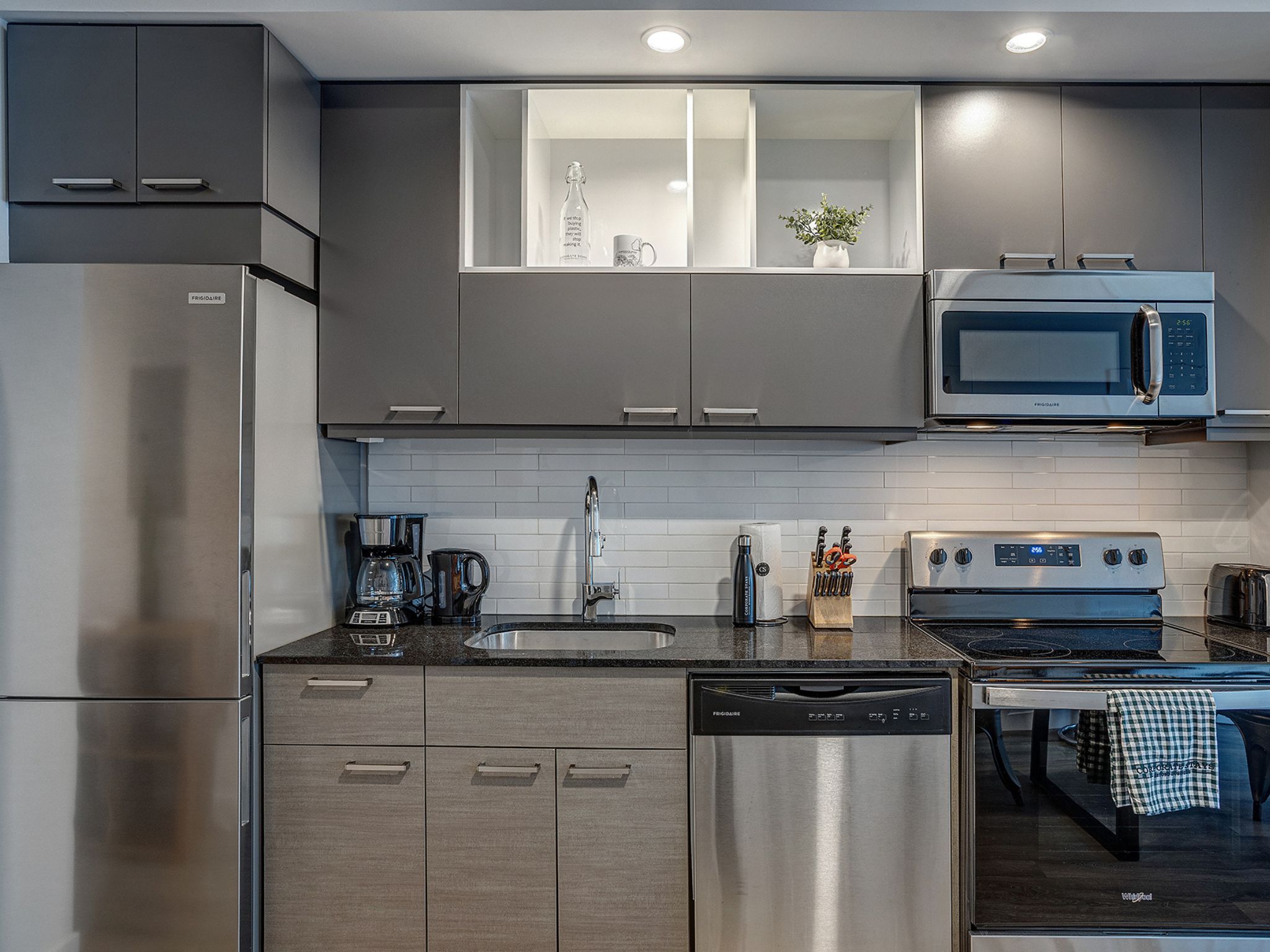
For the Business Traveler: Downtown & Griffintown
If you’re in Montreal for work — a project assignment, a conference stretch, a relocation bridge period — you want zero commute friction and a building that’s used to short stays.
Downtown (Ville-Marie) puts you inside the underground RESO network, which means you can walk to meetings, the metro, and food without ever touching the sidewalk in February. It’s the highest-density business core on the island, and furnished monthly listings here are built for exactly this kind of stay.
Griffintown, just southwest of downtown, has gone from industrial lots to glass condo towers over the last decade. It’s a five-to-ten-minute walk or one metro stop from the core, generally quieter at night than downtown proper, and popular with young professionals who want new construction over character.
Reality check on cost: downtown and the adjacent Le Sud-Ouest borough (which includes Griffintown and Saint-Henri) sit toward the top of the market. One-bedroom rents in that stretch average around $1,682/month and two-bedrooms around $2,014, according to Centris’s 2025 Montreal rental data — noticeably above the city-wide median.
Best for: short-notice project teams, consultants, anyone whose main requirement is “close to the office, no surprises.”
Browse furnished apartments downtown →
For the Remote Worker: Mile End & Rosemont–La Petite-Patrie
If you’re staying long enough to actually build a routine — a few weeks to a few months — proximity to an office matters less than whether the neighborhood is livable when you’re not working.
Mile End is the cafe-and-bakery neighborhood Montreal is known for internationally — think Saint-Viateur bagels and a genuinely high density of spots built for someone with a laptop and three hours to kill. It’s walkable, bilingual, and a short bike ride from downtown without living in the middle of it.
Rosemont–La Petite-Patrie trades a bit of that buzz for more breathing room: bigger parks (Maisonneuve, La Fontaine nearby), community gardens, and a slower daily rhythm, while staying fully connected via the Metro’s Rosemont and Beaubien stations.
Both neighborhoods sit in the middle of the market — noticeably cheaper than downtown or Le Sud-Ouest, and comparable to each other.
Best for: digital nomads, freelancers, and anyone doing a multi-week “live like a local” stay.
Browse furnished apartments in Rosemont & the Plateau area →
For the Family or Group: NDG & Villeray
Space is the constraint families run into first — Montreal’s older buildings are charming but small, and a family of four in a 600-square-foot Plateau walk-up gets old fast.
Notre-Dame-de-Grâce (NDG) is one of the more affordable central options, at roughly $1,640/month for a one-bedroom as of August 2026, according to Zumper’s rental data — and larger family-sized units follow the same relative discount. It’s residential, tree-lined, and has real grocery and school infrastructure rather than just restaurants.
Villeray–Saint-Michel–Parc-Extension is seeing some of the fastest rent growth on the island right now — Centris data shows three-bedroom units up over 20% year over year — which tells you families are actively moving there for the same reasons: green space, schools, and better value than Rosemont or the Plateau.
Best for: groups of 3+, families needing a second bedroom without a downtown price tag.
Browse family-sized apartments →
For the First-Time Visitor: Old Montreal & Le Plateau-Mont-Royal
If this is a shorter, exploratory trip and the goal is simply “see Montreal,” walkability and density of things-to-do beat everything else.
Old Montreal (Vieux-Montréal) is the postcard version of the city — cobblestone streets, the Notre-Dame Basilica, the Old Port — and staying inside it means most major sights are a walk, not a metro ride.
Le Plateau-Mont-Royal is the neighborhood most people picture when they picture Montreal living: iron staircases, murals, Mont-Royal Avenue’s café strip. It’s one of the most walkable areas in the country and puts you close to Parc La Fontaine and the base of Mont Royal itself.
Both are premium-priced relative to the rest of the island — you’re paying for location, not square footage.
Best for: short stays (a few days to two weeks) where sightseeing, not routine, is the point.
Browse Old Montreal & Plateau apartments →
For the Budget-Conscious Longer Stay: Villeray & Ahuntsic-Cartierville
If you’re staying a month or longer and cost matters more than being in the middle of everything, this is the pairing worth knowing.
Ahuntsic-Cartierville was the most affordable neighborhood on the island as of liv.rent’s May 2026 rent report, averaging about $1,370/month for an unfurnished one-bedroom — roughly $560 less than the most expensive comparable neighborhood, Saint-Henri, in the same report.
Villeray–Parc-Extension costs a bit more but still comes in well under the Plateau or downtown, with strong metro access via the orange line and one of the most diverse, market-and-café-driven main streets in the city (Jean-Talon).
Best for: longer relocations, students, and anyone prioritizing value over walking-distance sightseeing.
Browse budget-friendly apartments →
A Note on Furnished & Short-Term Rentals in Montreal
One thing most neighborhood guides skip: not every building in Montreal can legally host short-term or furnished monthly stays. Quebec requires short-term rental operators to hold a CITQ (Corporation de l’industrie touristique du Québec) classification, and the City of Montreal has its own borough-level restrictions on top of that — some boroughs limit short-term rentals to a host’s primary residence, for example.
This matters because it’s the difference between booking a fully compliant, professionally managed furnished unit and ending up in a listing that could get cancelled on you. Every property listed through MontrealStays is vetted for exactly this, which is one less thing to worry about wherever you land on this list.
Montreal Rent Snapshot by Neighborhood (2026)
| Neighborhood | Approx. 1BR Rent | Source |
|---|---|---|
| Ahuntsic-Cartierville | ~$1,370/mo | liv.rent, May 2026 |
| Milton-Parc | ~$1,495/mo | Zumper, Aug 2026 |
| Notre-Dame-de-Grâce (NDG) | ~$1,640/mo | Zumper, Aug 2026 |
| Le Sud-Ouest (Griffintown/St-Henri) | ~$1,682/mo | Centris, 2025 |
| City-wide average, Montreal | ~$1,765/mo | Zumper, Aug 2026 |
| Saint-Henri | ~$1,933/mo | liv.rent, May 2026 |
Figures are unfurnished one-bedroom averages and change monthly; treat them as reference points for comparing neighborhoods against each other, not fixed prices.
Book Your Stay
However you’re using this guide — a work trip, a long-term move, or a first look at the city — the process is the same three steps: find a property, check the reviews, and book with confidence.
Frequently Asked Questions
Downtown (Ville-Marie) or Griffintown, both of which put you within walking distance of the main business core and are well-served by furnished, monthly-ready buildings.
Ahuntsic-Cartierville and Villeray–Saint-Michel–Parc-Extension consistently rank among the most affordable neighborhoods with full metro access, based on 2026 rent data from liv.rent and Centris.
Yes — it’s regularly cited as one of the most walkable neighborhoods in Canada, with dense cafes, shops, and parks within a short walk of most addresses.
No. All the neighborhoods covered here have Metro or bus access; a car is optional rather than necessary anywhere on this list.
Yes, but operators need a CITQ classification and must follow borough-specific rules. Booking through a platform that vets listings for compliance removes the guesswork.
Griffintown is a specific, newer sub-area within the larger Le Sud-Ouest borough, which also includes Saint-Henri — Griffintown skews toward new-build condos, Saint-Henri toward converted industrial and older housing stock.